
Arguing Definitions, Ignoring Function?
When rejecting labels mattered more than explaining function

From the outset, the discussion over Amazon’s proposed Orland Park facility unfolded on two tracks that rarely intersected.
For the Village, the debate centered on words. Warehouse. Distribution center. Fulfillment center. Each carried zoning and land-use implications, and much of the Committee of the Whole discussion focused on rejecting those labels outright. Classification mattered because zoning compliance hinges on how a use is defined.
For residents, the concern was simpler. They were not litigating terminology. They wanted to understand what the building would actually do.
Those two conversations ran in parallel, often missing each other entirely.
This article builds on earlier coverage that examined how the Amazon proposal surfaced publicly only days before the Plan Commission meeting and then advanced rapidly through the approval process. That reporting traced the project’s timeline, scale, and early public response as the Village moved toward a vote.
Readers can find that coverage here:
Throughout the Committee of the Whole meeting, it was the Village — not Amazon — that did most of the explaining. The informational video shown to residents was produced and presented by the Village itself, not by the applicant.
That distinction matters. The framing residents heard was not merely Amazon’s characterization of its own project. It was the Village’s.
Village representatives repeatedly emphasized what the project was not.
“It will not be an Amazon warehouse or distribution center.”
-Village Promotional Video
Later, the same point was reiterated in response to public concern:
“…it’s going to be an Amazon fulfillment center. Is that correct? No. This project is not a fulfillment center, warehouse, or distribution hub. It’s a commercial retail store open to the public.”
-Village Promotional Video
The premise was clear. If the project could be defined as retail, then zoning questions associated with fulfillment centers or last-mile logistics would not apply. The Village focused on rejecting classifications, rather than affirmatively describing a single, unified use.
As the meeting progressed, however, the Village’s own explanations began to describe how the facility would operate — even as those labels continued to be resisted.
A pickup area dedicated to drivers was identified.
“…that uh pickup that we were referring to uh of the third party drivers.”
-Amazon Representative
The scale of the non-public portion of the building was also described.
“…100,000 square feet in the back of house.”
At that point, the discussion had moved beyond definitions. Through its own explanations, the Village outlined distinct operational components within the building. Retail customers and delivery drivers would interact with the facility differently, using separate access points.
The explanation was offered as clarification. Functionally, it described a bifurcated facility.
Outside of zoning and legal classification, words like warehouse and fulfillment center are not inherently controversial. A warehouse stores and moves goods. A fulfillment center does the same, optimized for online orders. Costco openly refers to itself as a warehouse retailer — for facilities smaller and less operationally complex than the one proposed by Amazon.
What made the terminology contentious here was not public misunderstanding. It was the legal consequence attached to classification.
That tension surfaced most clearly when Trustee Katsenes asked a direct operational question.
“If a resident in Orland ordered something online. Would that product in any way filter through the new Amazon facility being built in Orland Park?”
She grounded the question in prior descriptions, noting that the example used by the Amazon attorney which referenced consumer goods rather than groceries.
“Say the red sweater. Let’s use the red sweater.”
The question was straightforward: does this building participate in online order flow or not?
The question was not directly answered. Instead, the response focused on internal support functions.
“So everything that’s coming in and will the back of the house always supports the front of the house.”
What was established, through the Village’s own descriptions, was that goods would move through a substantial back-of-house operation, with delivery drivers accessing a dedicated logistics area separate from customers.
As the meeting continued, another discrepancy emerged — this one involving numbers rather than labels.
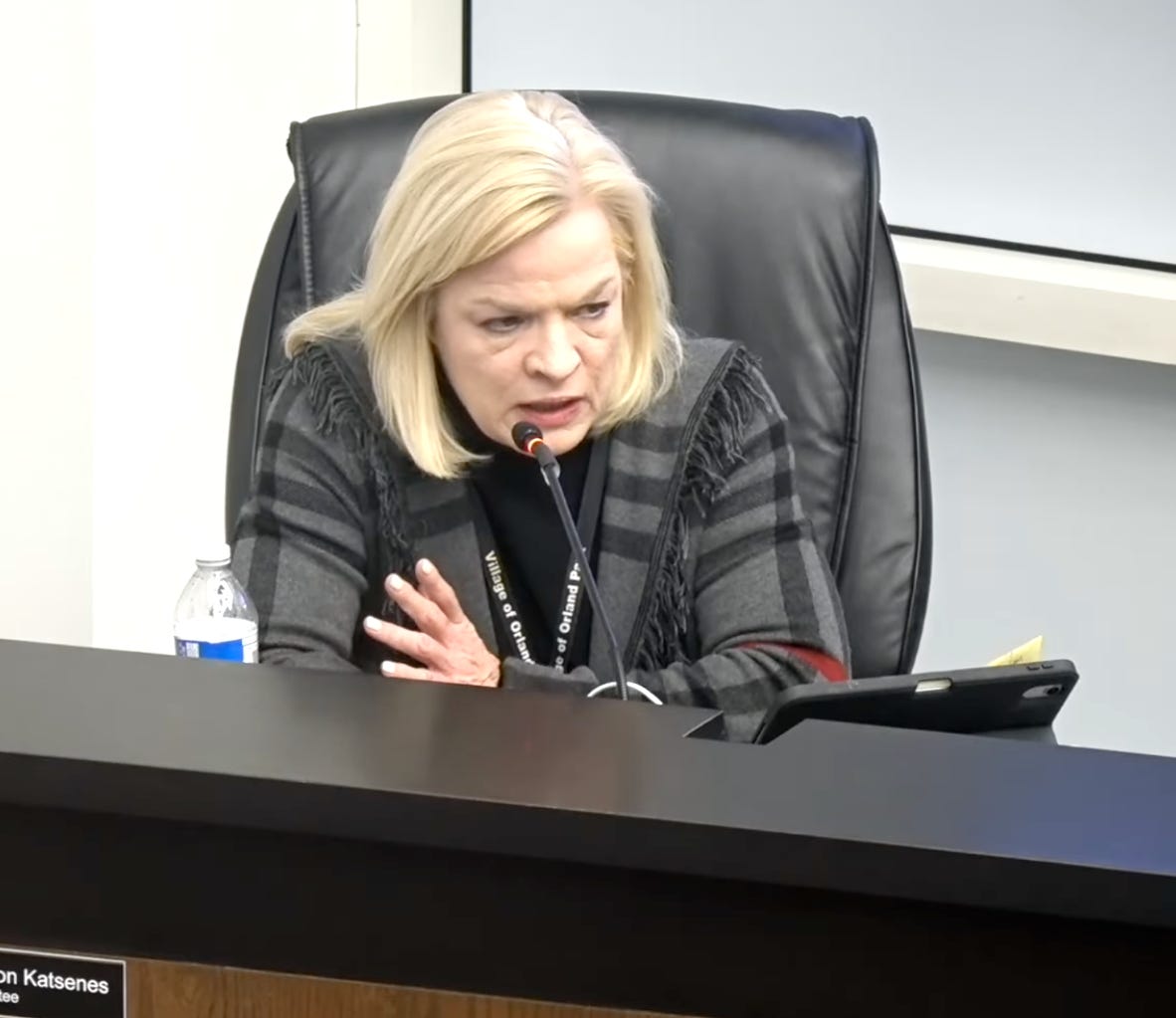
Trustee Katsenes noted that during the Plan Commission review, Amazon had represented that the project would involve “less than 10” semi-truck deliveries per day. By the time of the Committee of the Whole meeting, that figure had been revised to 27 per day.
The change was acknowledged as an “error.” Amazon’s attorneys stated that the revised number did not alter the conclusions of the traffic study already performed, while also indicating that a new traffic study would be conducted approximately one year after opening.
The contrast was notable. A nearly threefold increase in truck traffic was described as immaterial, yet significant enough to revisit later.
Trustee Katsenes attempted to refer the matter back to the Plan Commission — a procedural step used in the past when material information emerges after advisory review. That option was not offered. The only paths presented were to end debate or table the item.
The Board proceeded using a recommendation formed under a different factual assumption.
Context around the Plan Commission itself added another layer.
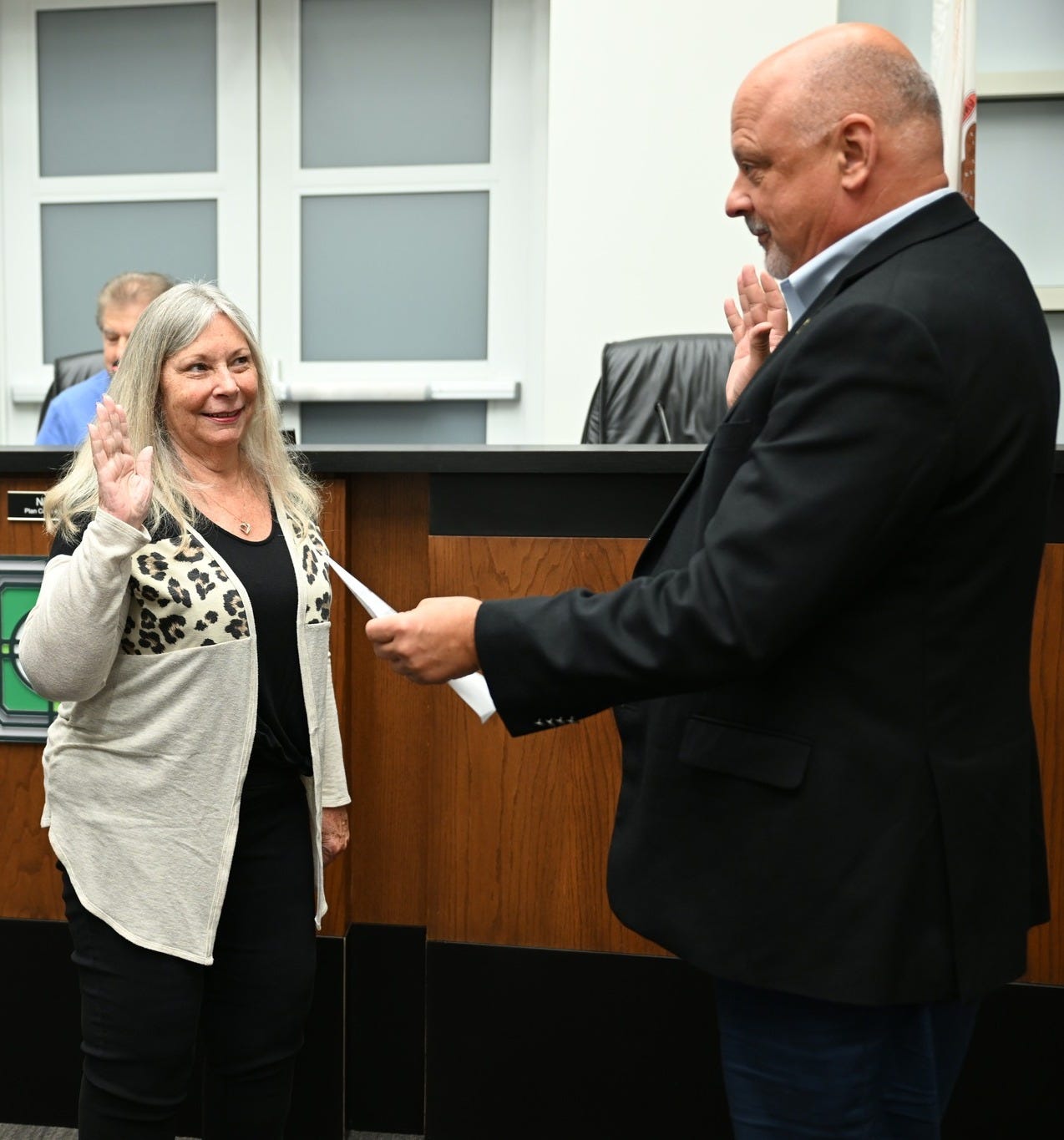
Just weeks before the Amazon proposal was reviewed, Kathy Fenton — a longtime trustee who served for decades alongside Mayor Dodge — was appointed to the paid advisory commission. During the Plan Commission meeting, her suggestion that the building be “spruced up” so it would not “look like another box” became the only changes Amazon made following the review. No operational revisions followed — only aesthetic ones.
Separately, Fenton also served as chair of a political action committee that publicly welcomed Amazon’s development before the Plan Commission completed its review, framing the project as a fait accompli while the advisory process was still underway.
None of these facts alone establish impropriety. Taken together, they reinforce a pattern in which momentum appeared to outpace deliberation.
That pattern extended to the Board itself.
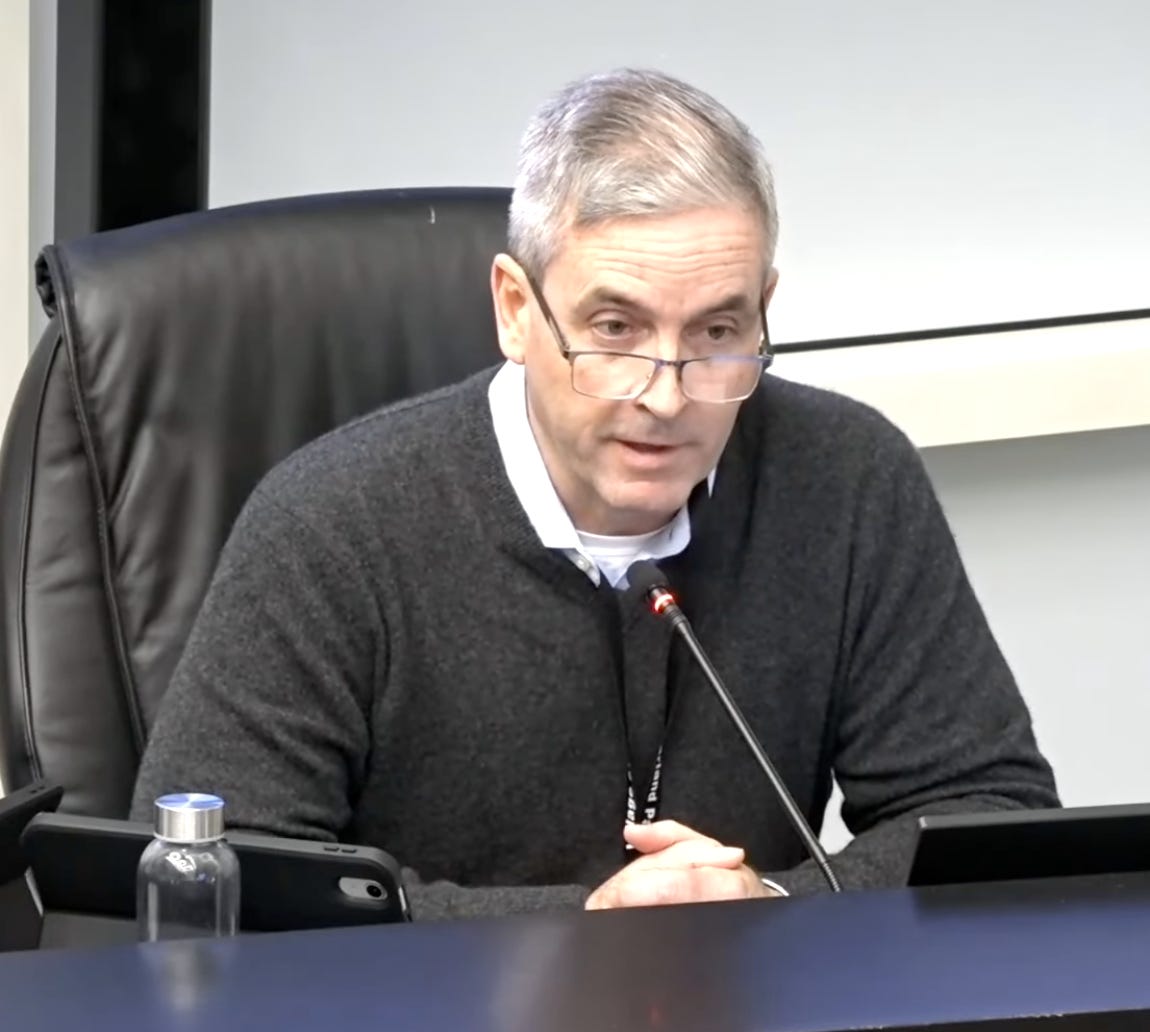
During the Committee of the Whole discussion, Trustee Lawler stated that he had been involved in early planning discussions beginning as far back as May and that his questions had been answered. Other trustees indicated they had no knowledge of the project until it appeared before the Plan Commission.
The issue was not whether early discussions were permissible. It was whether they created an uneven informational landscape — where some decision-makers felt fully briefed long before the public process began, while others were expected to deliberate in real time.
Later that same evening, the proposal advanced directly from the Committee of the Whole to the Board of Trustees and was approved that night.
Under standard practice, Board agenda items are required to be posted more than 48 hours in advance. Same-night advancement typically reflects non-controversial items or unanimous advisory support.
This proposal had neither.
By contrast, Naperville debated a proposed data center of comparable scale for months before rejecting it. The difference is not ideological. It is procedural.
Media coverage mirrored the same uncertainty seen locally. Depending on the outlet, the project was described as a retail concept, a big-box store and fulfillment center, a grocery store, or a warehouse — underscoring how difficult it was, even for reporters, to clearly define the facility’s function.

A “First-of-Its-Kind” Claim, in Context
National reporting this week adds even further context to the questions raised locally.
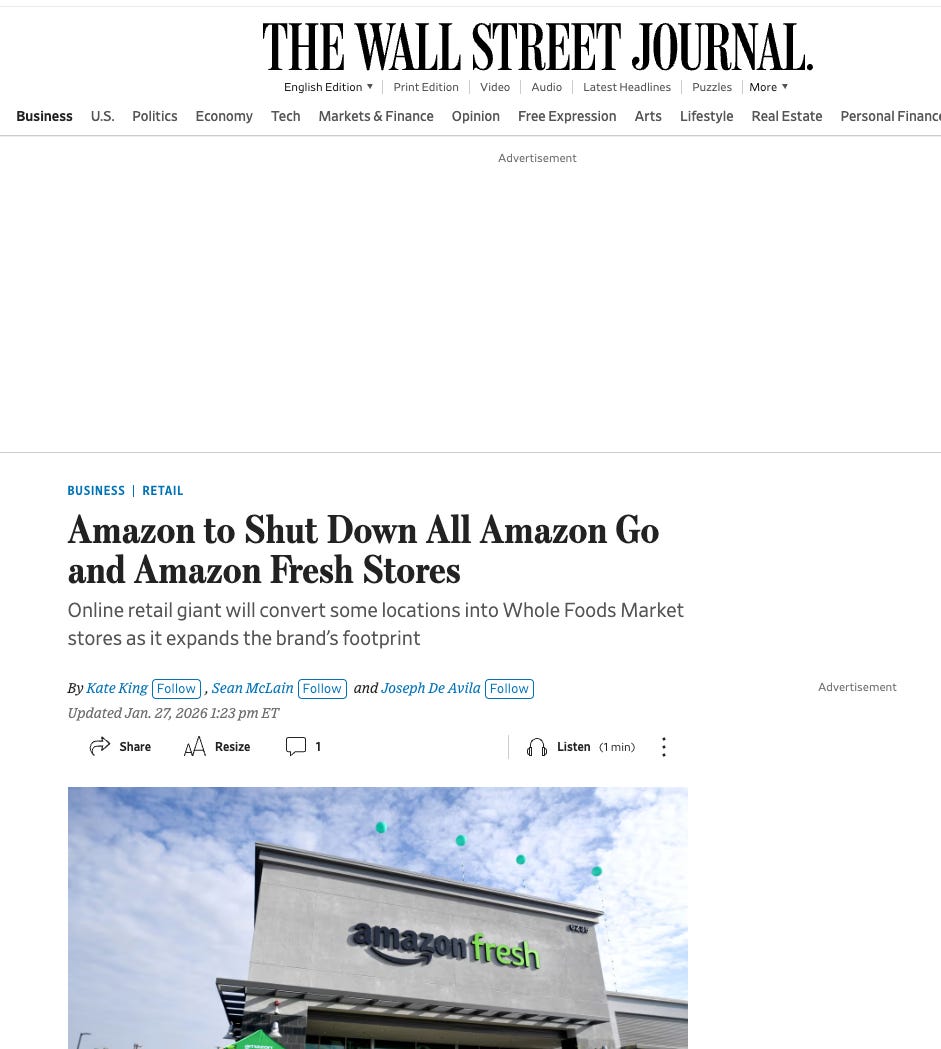
Amazon’s track record with physical retail “experiments” has been trending downward, not upward. In recent years, the company has closed or scaled back several branded store formats, including Amazon Go and Amazon Fresh locations, while shifting its focus toward delivery, logistics, and fewer, more flexible physical footprints. Concepts once introduced as innovative have been quietly wound down or restructured.
Against that backdrop, repeated references to the Orland Park project as “first-of-its-kind” warrant scrutiny. Novelty in branding does not guarantee novelty in function, and Amazon’s own history suggests that many physical formats are transitional rather than fixed.
That broader context matters because it reframes the local debate. Residents were not simply reacting to unfamiliar terminology. They were trying to understand how a large, logistics-supported facility would operate over time — particularly given Amazon’s pattern of evolving, repurposing, or abandoning physical retail concepts altogether.
Whether Amazon’s representatives were aware that news of Amazon Fresh closures was imminent is unknown. What is observable is the timing. As Amazon was quietly retreating from branded grocery formats like Amazon Fresh and Amazon Go, the Orland Park proposal increasingly emphasized a grocery-forward retail identity — despite a Whole Foods location operating just down the street.
That shift did not resolve residents’ questions about function. It reframed them. A grocery label may fit more comfortably within zoning definitions, but it does little to explain a facility with a substantial back-of-house operation, dedicated driver access, and logistics circulation described during the Village’s own presentations.
It also casts the speed of the approval process in a different light. The project moved from Plan Commission to Committee of the Whole to Board approval in just 17 days, with the final vote occurring the same night as the Committee discussion. That pace left little room for public digestion, follow-up questions, or reassessment as new information emerged.
In Orland Park, the discussion focused on what the project was not. The function followed quietly behind, shaped by explanations, examples, and assumptions — and approved before those questions could fully settle.
In the end, the Village chose the words. The function followed quietly behind — whether it matched them or not.
The full discussion can be found here at approximately the 26:00 minute mark.
Thank you for reading another page in The OPen Record.
Other articles on the Village: